
FLOOD EMERGENCY RESPONSE PROJECT
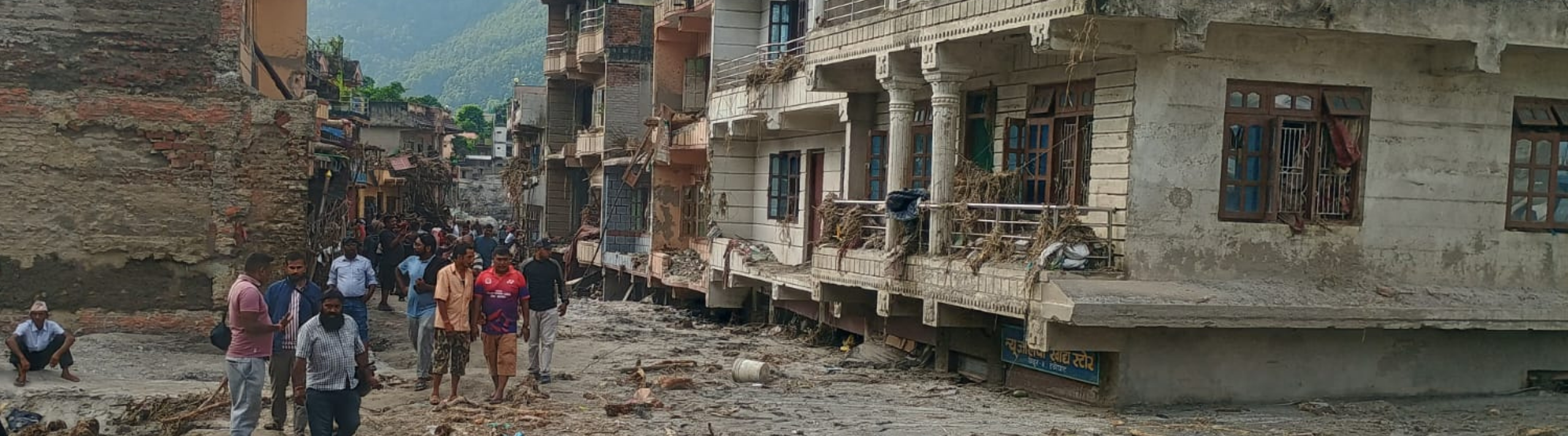
On 26 August 2026, Nepal was hit by an exceptionally severe flood event. A massive mass of ice and rock, hundreds of metres wide, broke away at high altitude and fell more than one kilometre down the narrow Lhende Khola valley. The impact generated a seismic signal equivalent to a magnitude 5.2 earthquake, triggering devastating mud and debris flows along the Lhende Khola–Bhote Koshi–Trishuli river system. The event particularly affected Rasuwa District before spreading downstream towards Nuwakot, Dhading and other districts.
More than a month after the disaster, many communities continue to face significant needs. Access to the most remote areas remains difficult, and families have not received the same level of assistance. Alongside material needs, communities are facing challenges related to access to water and health services, protection, psychosocial support and the ability to cope with the winter season in adequate conditions.
To better understand the situation and direct support towards needs that remain insufficiently covered, Apeiron has worked with the Nepali organisations FOCUS Nepal and PRERANA, which have carried out rapid needs assessments in the affected areas, in coordination with local authorities and other actors involved in the response.
OUR EMERGENCY RESPONSE
Based on the information collected, Apeiron ODV has developed an integrated intervention in Rasuwa District, with a particular focus on the Rural Municipalities of Uttargaya and Kalika.
The project will initially run for 9 months and will combine emergency assistance, restoration of and access to essential services, protection and psychosocial support. The intervention will be implemented progressively and flexibly, allowing activities to be adapted as needs evolve.
The aim is to support families whose needs remain insufficiently covered and, when conditions allow, accompany them towards greater stability and the recovery of their livelihoods.
- SUPPORTING FAMILIES STILL FACING DIFFICULTIES
An important part of the intervention will focus on families who, following the floods, continue to face essential needs that have not been adequately met.
Essential items and materials to help families cope with the winter season will be distributed based on needs actually identified in the communities. The project will also include a financial assistance component, delivered through existing local mechanisms and coordinated with the authorities, to reach families most in need.
Particular attention will be given to people facing greater vulnerability and families that have received limited assistance.
- RESTORING ACCESS TO WATER AND ESSENTIAL SERVICES
The floods damaged infrastructure and services that are essential to everyday life.
Through FOCUS Nepal, the project will support improved access to safe water, hygiene and sanitation, based on technical assessments and priorities identified together with communities and local authorities.
The project will also support local health facilities through the provision of supplies and equipment identified according to the needs that remain.
- STRENGTHENING PROTECTION AND PSYCHOSOCIAL SUPPORT
An emergency of this scale causes more than material damage. For many people, it means losing their homes, livelihoods, points of reference and, in some cases, family members.
The project will therefore provide psychosocial support, training for frontline staff in Psychological First Aid (PFA), and specific attention to situations of vulnerability and protection risk.
Particular attention will be given to women and girls, boys and girls, older people, persons with disabilities and people with specific protection needs.
When necessary, and with due respect for consent and confidentiality, people will be supported in accessing specialised services available locally or in Kathmandu.
- FACILITATING ACCESS TO SPECIALISED SERVICES
Collaboration with Apeiron Nepal will strengthen the identification and referral of people who need specialised protection, psychosocial or health services.
Based in Kathmandu, Apeiron Nepal brings extensive experience in protection and response to violence and may, where appropriate, facilitate access to CASANepal, a protection and accommodation service for women and children who have survived situations of violence.
Referrals will be made on a case-by-case basis, respecting safety, informed consent, confidentiality and the principle of Do No Harm.
- FROM EMERGENCY TO RECOVERY
The intervention will not necessarily stop at immediate assistance.
When conditions allow, an early livelihood recovery component may be considered to support affected families in restoring their means of subsistence.
Any decision to activate this component will be preceded by a specific assessment of productive activities, local market conditions and realistic recovery opportunities. Support could, for example, be provided for agricultural activities, small-scale livestock farming and other economic activities already present in the communities.
This component will only be activated when conditions make it feasible and without reducing resources available for outstanding emergency needs.
HOW WILL WE WORK?
The project will be implemented through a single, coordinated response involving APEIRON ODV, Apeiron Nepal, FOCUS Nepal and PRERANA.
PRERANA will primarily implement direct assistance to families and the distribution of essential and winterization items.
FOCUS Nepal will work on water, hygiene and sanitation, health, financial assistance to families and psychosocial support.
Apeiron Nepal will contribute from Kathmandu through its expertise in protection, psychosocial support and referrals to specialised services.
APEIRON ODV will ensure overall coordination of the intervention, technical and financial oversight, monitoring and donor relations.
The project will be implemented in continuous coordination with local authorities and other actors involved in the response, with the aim of avoiding duplication and using available resources as effectively as possible.
WHO ARE WE AIMING TO REACH?
The project will support families and people most affected by the floods in the areas of Uttargaya and Kalika, identified through assessments, field verification and consultation with local authorities.
Indicatively, around 1,000 families will be reached through material and winterization assistance, while approximately 315 families, representing around 1,575 people, will benefit from water, hygiene and essential services interventions.
Additional people will be reached through financial assistance, health services, psychosocial support and protection activities.
These figures do not represent separate groups: the same family may benefit from more than one form of assistance, depending on its needs.
Particular attention will be given to women and households headed by or including women living alone, boys and girls, older people, persons with disabilities and people with specific protection needs.
A FLEXIBLE AND COORDINATED RESPONSE
The response will be needs-based, complementary and flexible.
Before providing assistance, we will verify, as far as possible, the support already received by families and the activities carried out by other organisations and institutions working in the area. Coordination with local authorities and existing response mechanisms will be essential to reduce the risk of duplication and reach those who have been most excluded from assistance.
The project may also be adapted during implementation as the situation evolves. Monitoring needs, engaging with communities and gathering feedback from people involved will help ensure that activities remain genuinely useful and appropriate.
The aim is to gradually accompany families from immediate assistance towards greater safety, stability and autonomy, while continuing to address the emergency needs that remain.
HOW TO SUPPORT THE EMERGENCY
The intervention will start in October 2026 and will have an initial duration of 9 months.
If you too would like to support communities affected by the floods and to contribute to emergency response and recovery activities, you can do so through:
- bank transfer to the account held by Apeiron ODV at BANCA INTESA SANPAOLO
IBAN: IT22Q0306909606100000103529
ABI: 03069 CAB: 09606 BIC: BCITITMM
CC: 1000/103529 - or by donating online through the simple PayPal system
Even a small donation, combined with many others, can turn into concrete help.
Because Nepal is far away, but some bonds know no distance.
